
Watering & Pond Care

Getting water to the roots without wasting it — and keeping the pond clear the natural way.
Watering is the job gardeners most often get wrong: too little, too late, and applied faster than the soil can take it. Most of what follows is about matching the delivery of water to the way roots actually drink — slowly, steadily, and at soil level rather than over the foliage. None of it needs chemicals, and all of it saves time in the height of summer.
Capillary matting
Capillary matting is a thick, felted fabric that wicks water sideways from a reservoir and holds it against the base of a pot. Water moves through the fibres by capillary action, so a compost-filled pot standing on the mat draws up exactly what it needs and no more. It is the closest thing to self-watering that a greenhouse shelf can offer.
Set it up by cutting the mat to the length of your staging and laying one end in a tray or trough of water kept topped up. The mat should slope very slightly down towards the dry end so gravity helps the flow. Stand pots directly on the mat, unblocked — a pot with a deep saucer or a chunky foot will break contact and stop drawing water. Keep the mat shaded; strong sun on wet felt grows algae and the mat soon clogs. In practice, a well set up run of capillary matting will hold tomatoes, peppers and bedding on course for a week or more in July, which makes it the single most useful piece of kit for anyone who works away or simply cannot water twice a day.
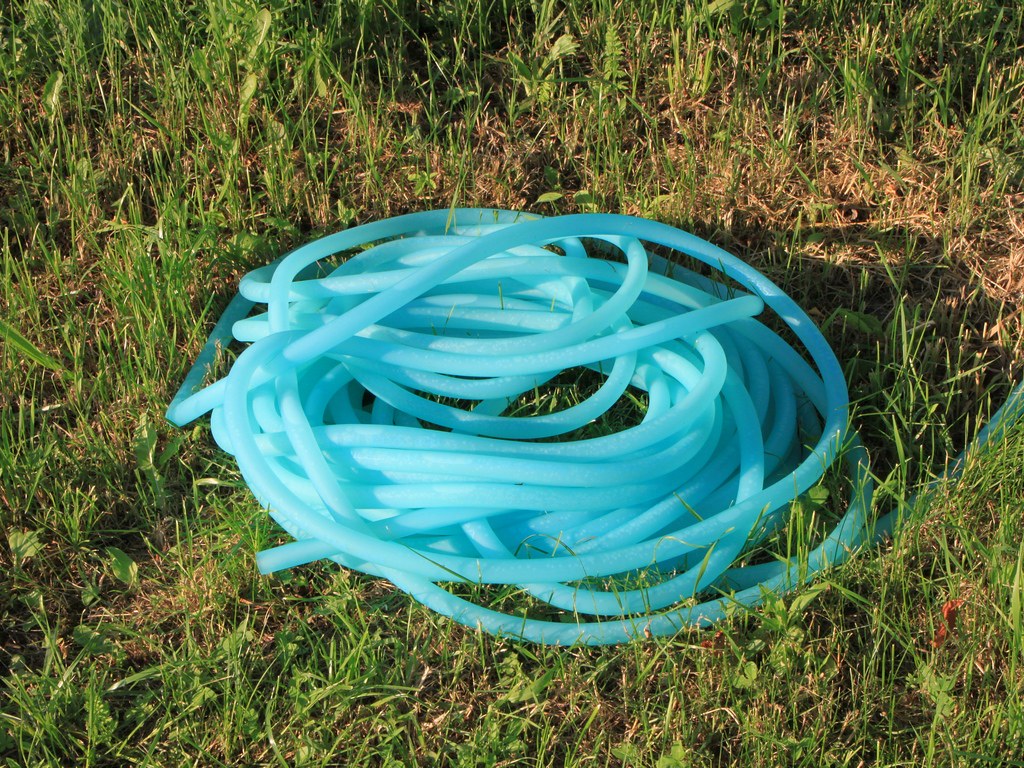
Soaker hose
A soaker hose is a porous rubber or recycled-polymer tube that seeps water along its entire length at low pressure. Laid between rows and covered with a thin mulch, it delivers water straight to the root zone, so very little is lost to evaporation and none is thrown onto foliage — one of the main routes by which mildew and blight spread.
A few things make the difference between a soaker hose that works and one that does not:
- Keep runs short. Around 15–20 m is the practical limit on mains pressure before the far end stops weeping evenly. Longer beds are better served by two shorter runs on a splitter.
- Run it low and slow. Half an hour at a trickle will do more good than five minutes at full bore, because it lets the soil absorb rather than shed the water.
- Lay it the right way up. Most hoses have small emission holes and should sit hole-side up, with the flat side down, so water drips rather than jets.
- Mulch over it. A layer of compost or grass clippings keeps the surface cool, suppresses weeds and hides the hose.
- Drain it before winter. Water left inside a soaker hose freezes and splits the wall.
For grow bags, raised beds and containers, a soaker hose on a timer is the difference between a decent crop and a split, bitter tomato.
Grow bag watering bottles
The problem with a grow bag is its shape: shallow, wide and quick to dry, with a small compost volume relative to the leaf area above it. Water poured on the surface runs off the sides and out of the drainage holes before it has soaked in. Grow bag watering bottles solve this by pushing water down into the body of the compost through a perforated spike, releasing it slowly.
Sink two bottles per standard grow bag, one either side of the plants, and fill them through the neck. Refilling every two or three days in hot weather keeps the compost evenly moist from top to bottom instead of alternating between bone dry and saturated. The same bottles are excellent in large patio pots and in hanging baskets, and they let you add a dilute liquid feed directly to the root zone rather than pouring it over the leaves.
Barley straw for clear pond water
Green water is caused by suspended algae, and algae are driven by sunlight and dissolved nutrients. Barley straw works as the straw decomposes in the pond: it releases lignin compounds which, in the presence of sunlight and oxygen, break down into substances that suppress new algal growth. It does not kill algae already in the water, and it does not clear an established bloom overnight — it prevents the next one. That is why it is best put in early, in spring, before the water warms and the algae get their start.
Use roughly 50 g of straw per cubic metre of water, loosely packed in a mesh bag so it stays aerated. Anchor it just below the surface where there is light and water movement — a floating bag is useless because it dries out and stops decomposing. Keep the pond well oxygenated with a pump or fountain, remove dead leaves and blanket weed so they do not rot back into nutrients, and expect the straw to need replacing after about six months. In a well-managed pond the result is water you can see the fish through, with no potions and no harm to frogs, newts or plants.
Getting the balance right
Whichever method you use, water in the evening or early morning and check the soil with a finger rather than a calendar. Damp two inches down means leave it alone; dry at that depth means it is time. Consistent moisture, delivered slowly and at root level, prevents splitting, bolting and blossom end rot far more reliably than any amount of catch-up watering after the damage is done.
At a glance
- Capillary matting — wicks water to pots from a reservoir; keep it shaded and in full contact.
- Soaker hose — 15–20 m runs, low pressure, mulched over, drained before winter.
- Grow bag bottles — two per bag, refilled every few days in hot weather.
- Barley straw — 50 g per cubic metre, bagged below the surface, in place by spring.
A note on timing
Early morning watering suits ponds and greenhouses; evening suits open ground, where less is lost before the roots can take it up. Avoid the middle of a hot afternoon entirely.
All of these products sit in our Watering & Pond Care range, alongside soaker hose fittings and spare mesh bags for barley straw.